
The next phase of AI competition may be shaped not only by who builds the best models—but by who can secure the infrastructure required to run them.
For years, the race in artificial intelligence appeared to revolve around a familiar question:
Who can build the best model?
More capable models. Faster training. Better benchmarks. More advanced reasoning.
Those questions still matter. But the AI race is increasingly being shaped by something more fundamental:
Who can secure the infrastructure required to run intelligence at scale?
Behind every large language model, AI agent and generative application is a vast physical system of advanced chips, data centers, electricity, cooling and networks.
As AI demand accelerates, access to that infrastructure is becoming more than an operational requirement. It is becoming a strategic advantage.
AI Has Moved the Data Center to Center Stage
For much of the digital era, data centers remained largely invisible. They powered cloud computing, enterprise software and online services from behind the scenes. AI is changing that.
The rapid growth of AI workloads has moved data centers from the background of the digital economy to the center of the technology conversation.
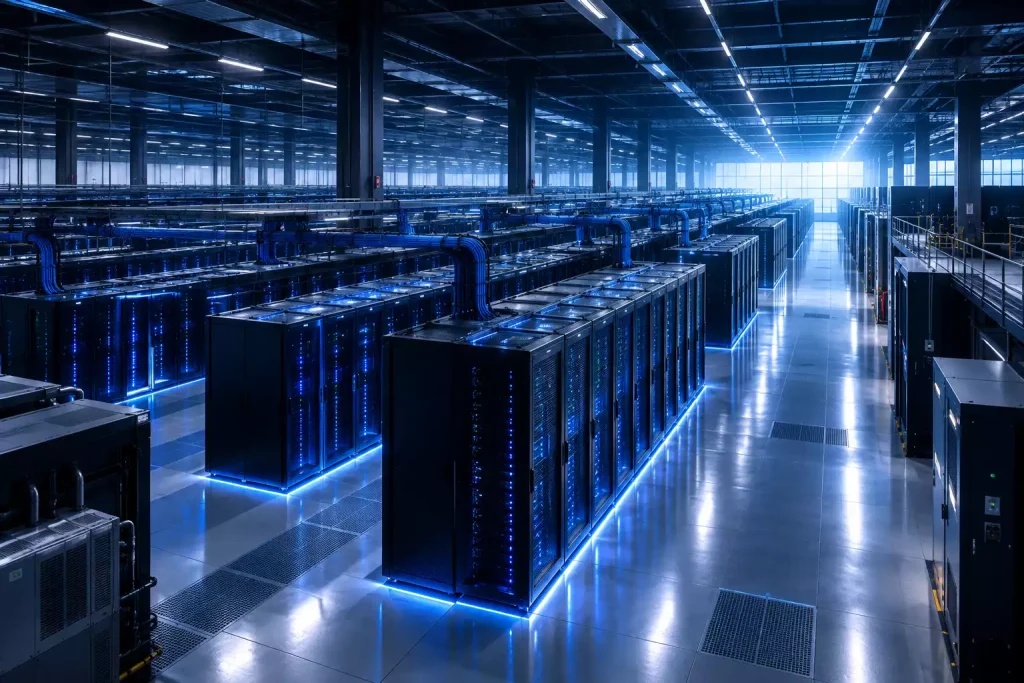
According to McKinsey, global demand for data center capacity could grow from approximately 82 gigawatts in 2025 to around 220 gigawatts by 2030.
AI is expected to be the primary driver of that growth. Non-AI demand could rise from around 38 gigawatts to 64 gigawatts during that period. AI-related demand, however, could increase from approximately 44 gigawatts to 155 gigawatts.
By 2030, AI could account for roughly 70 percent of total data center demand. That changes the nature of the AI conversation. The challenge is no longer simply whether organizations can develop more capable models. It is whether they can secure the physical capacity required to operate them.
Compute Is Becoming a Strategic Resource
The importance of computing capacity is becoming increasingly visible in the decisions of leading AI companies.
As demand for AI services grows, companies are making larger and longer-term commitments to secure access to infrastructure. This reflects a fundamental shift. In the earlier stages of the AI boom, compute was often treated primarily as a technical resource—something engineers needed to train and deploy models.
Today, it is increasingly becoming a strategic resource. Access to advanced compute can influence:
- How quickly a company can train new models
- How many users it can serve
- How rapidly it can scale AI products
- How much control it has over its technology roadmap
- How exposed it is to infrastructure shortages
The recent race to secure large-scale compute capacity reflects this new reality. The AI industry is beginning to look less like a competition based only on algorithms and more like a competition across an entire industrial infrastructure stack.
The AI Race Is Built on Physical Infrastructure
AI often feels like an entirely digital technology. But the infrastructure behind it is deeply physical. Running AI at scale depends on a complex system that includes:
Advanced chips. Data centers. Electricity. Cooling systems. Networking infrastructure.
A bottleneck in any one of these layers can slow everything above it. This is one of the defining characteristics of the current AI era:
Progress in software is increasingly constrained by the physical world.
A company may have the capital, talent and models needed to scale AI. But without sufficient power, chips, data center capacity or network connectivity, growth can still be delayed.
The intelligence may be digital. The constraints are not.
The New Bottleneck Is Not Just the GPU
Much of the public conversation around AI infrastructure has focused on GPUs and advanced accelerators.
They are critical. But they are only one part of the equation. A large-scale AI system also needs somewhere to operate.
That means data centers capable of supporting increasingly dense and power-intensive computing environments.
Those facilities require:
- Reliable electricity
- Advanced cooling systems
- Transformers
- Generators
- Switchgear
- Fiber connectivity
- Specialized construction
- A supply chain capable of delivering critical equipment on time
McKinsey’s analysis highlights how these constraints are reshaping the economics of AI infrastructure. Electricity is one of the most important drivers of cost differences between markets, while power and cooling equipment also play a major role.
In other words:
Access to compute increasingly depends on access to physical infrastructure.
And that infrastructure is becoming harder—and slower—to secure.
Geography Is Becoming Part of AI Strategy
The location of AI infrastructure matters. Some regions have advantages in electricity availability and cost. Others have stronger digital ecosystems, deeper network connectivity and closer proximity to users and enterprise customers.
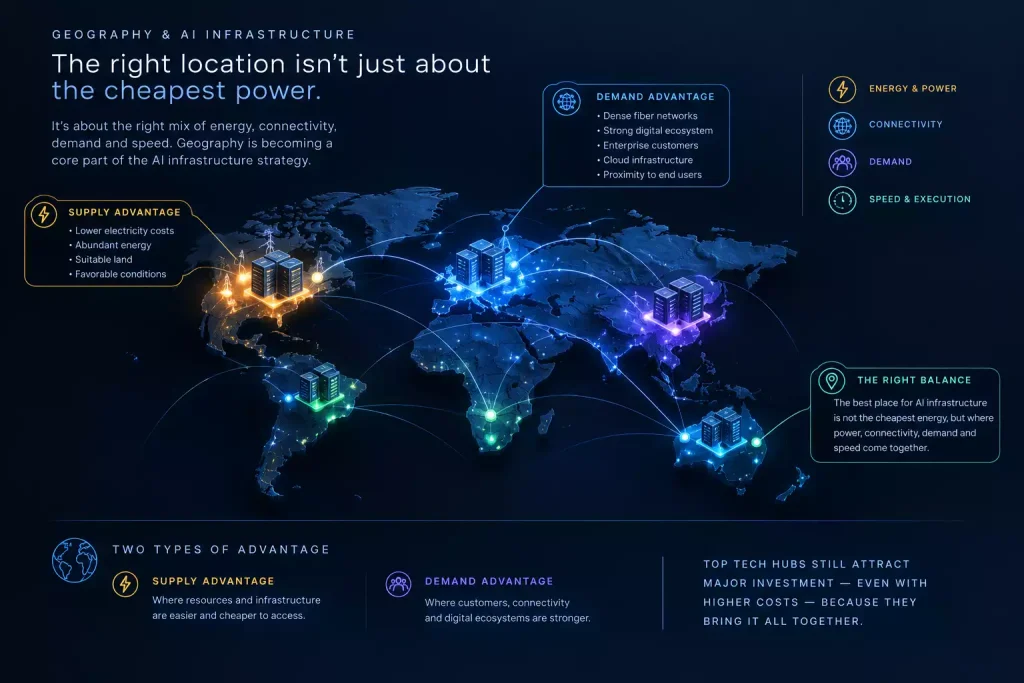
This creates two different kinds of advantage:
Supply advantage
Regions with:
- Lower-cost electricity
- Greater energy availability
- Suitable land
- Favorable conditions for expansion
Demand advantage
Regions with:
- Dense fiber networks
- Strong digital ecosystems
- Enterprise customers
- Cloud infrastructure
- Proximity to major users
The most attractive location for AI infrastructure is therefore not necessarily the place with the cheapest electricity. It may be the place where power, connectivity, customers and speed of deployment come together.
This is why established technology hubs can continue attracting investment even when they are more expensive to build in.
Why Chips Can Change the Economics
Infrastructure alone does not determine AI competitiveness. The efficiency of the hardware running inside that infrastructure matters just as much.
A region may have:
- Affordable electricity
- Competitive construction costs
- Large amounts of available land
But if it does not have access to highly efficient AI accelerators, it may need more hardware and more energy to produce the same amount of computing power. That changes the economics.
Less efficient hardware can mean:
- More chips
- More electricity
- More physical space
- More cooling
- Higher operating costs
This is why the race for AI infrastructure cannot be separated from the race for advanced chips.
Data center economics and compute economics are increasingly interconnected.
Speed Is Becoming a Competitive Advantage
The AI infrastructure race is not only about who can build the biggest facilities. It is also about who can build them first.
As demand accelerates, delays in:
- Permitting
- Grid connections
- Equipment delivery
- Construction
can become strategic disadvantages.
McKinsey notes that lead times for critical components such as generators, chillers, transformers and switchgear have increased significantly in recent years. Grid connections have also emerged as a major bottleneck.
In some markets, connecting a new facility to sufficient power can take years. This creates a new competitive reality. A company or region may have access to capital and land but still lose momentum if it cannot bring new infrastructure online quickly enough.
In this environment:
Speed to capacity may become almost as important as the cost of capacity.
From Model Competition to Infrastructure Competition
The AI industry is evolving beyond a simple competition between models. The next phase of competition will increasingly take place across multiple interconnected layers.
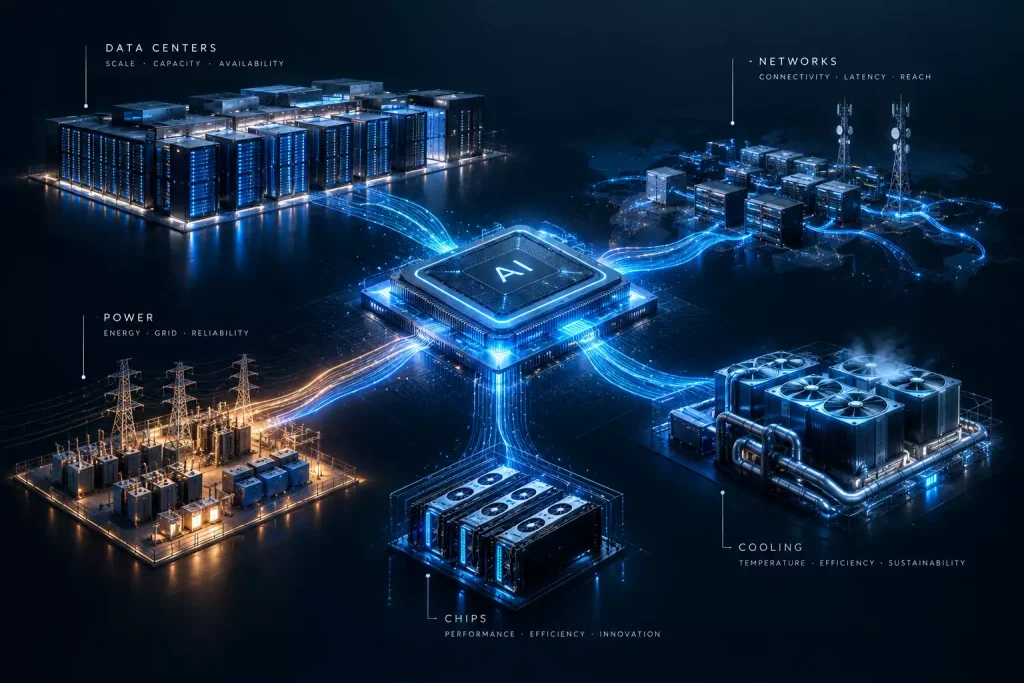
Models
Who can build more capable AI systems?
Compute
Who can secure the processing capacity needed to train and run them?
Data Centers
Who has access to facilities capable of supporting AI workloads at scale?
Power
Who can secure sufficient and reliable electricity?
Networks
Who can connect infrastructure, applications and users efficiently?
These layers are becoming increasingly difficult to separate. A breakthrough in model capability may have limited commercial impact if the infrastructure required to deploy it cannot scale.
Likewise, access to vast infrastructure may have limited value without the models, software and applications capable of turning that capacity into useful intelligence.
The next phase of AI competitiveness will depend on the ability to coordinate the entire stack.
Why This Matters Beyond Big Tech
At first glance, the AI infrastructure race may seem relevant only to companies building frontier models or hyperscale data centers. But its consequences will extend much further.
Businesses adopting AI will increasingly depend on infrastructure decisions made by:
- Cloud providers
- AI companies
- Chip manufacturers
- Data center operators
- Energy providers
- Governments
The availability and cost of compute could eventually influence:
- The cost of AI services
- The availability of AI capabilities
- Where AI workloads can be deployed
- The resilience of AI-dependent operations
- How dependent organizations become on a small number of infrastructure providers
For business leaders, this means AI strategy cannot be completely separated from infrastructure strategy. Organizations do not necessarily need to build their own data centers. But they do need to understand the infrastructure dependencies behind their AI ambitions.
The Henarco View
The conversation around AI has been dominated by models.
Which model is smarter?
Which model reasons better?
Which model performs best?
Those questions are important—but increasingly incomplete. The next strategic divide in AI may not be defined only by intelligence.
It may be defined by access:
Access to compute.
Access to power.
Access to infrastructure.
And access to the physical systems required to turn AI capability into real-world scale.
For organizations, this means the AI conversation needs to become broader. Choosing a model is only one decision. Understanding the infrastructure behind that model—and the dependencies that come with it—will become increasingly important.
The companies best positioned for the next phase of AI may not simply be those using the most advanced models. They may be the ones asking better questions about the systems those models depend on.
Better Questions
Instead of asking only:
Which AI model should we use?
Organizations should begin asking:
How dependent are our AI capabilities on external compute infrastructure?
What happens if capacity becomes constrained or significantly more expensive?
Which AI workloads are truly strategic to our business?
Where should those workloads run?
How much control do we need over the infrastructure behind our AI systems?
What dependencies are we creating on cloud, model and infrastructure providers?
How will cost, resilience and availability change as AI usage scales?
Are we building an AI strategy—or simply consuming AI capacity?
These questions will become more important as AI moves from experimentation into critical business operations.
The Strategic Question Is Changing
Until recently, many organizations approached AI with a relatively straightforward question:
Which AI model should we use?
That question is still important. But the next question may be even more consequential:
What infrastructure will we depend on to run AI at scale?
As AI becomes more deeply integrated into products, workflows and operations, infrastructure choices will increasingly shape:
Cost.
Flexibility.
Resilience.
Availability.
Long-term competitiveness.
The companies that succeed in the next phase of AI may not simply be those with the most intelligent models. They may also be the ones that understand something more fundamental:
Intelligence at scale requires infrastructure at scale.
And in the emerging AI economy, access to that infrastructure is becoming a strategic asset in its own right.
