
Artificial intelligence is scaling at extraordinary speed. But behind the race to build larger models and deploy more powerful AI systems, another race is quietly taking shape:
the race for electricity.
For years, the discussion around AI infrastructure has focused primarily on computing capacity, chips and data centers. Yet as AI deployment moves from experimentation to industrial scale, a different constraint is becoming harder to ignore.
AI needs enormous amounts of power — and the power system cannot always expand at the same speed as the technology.
This may become one of the defining constraints of the next phase of AI.
AI Has an Energy Problem
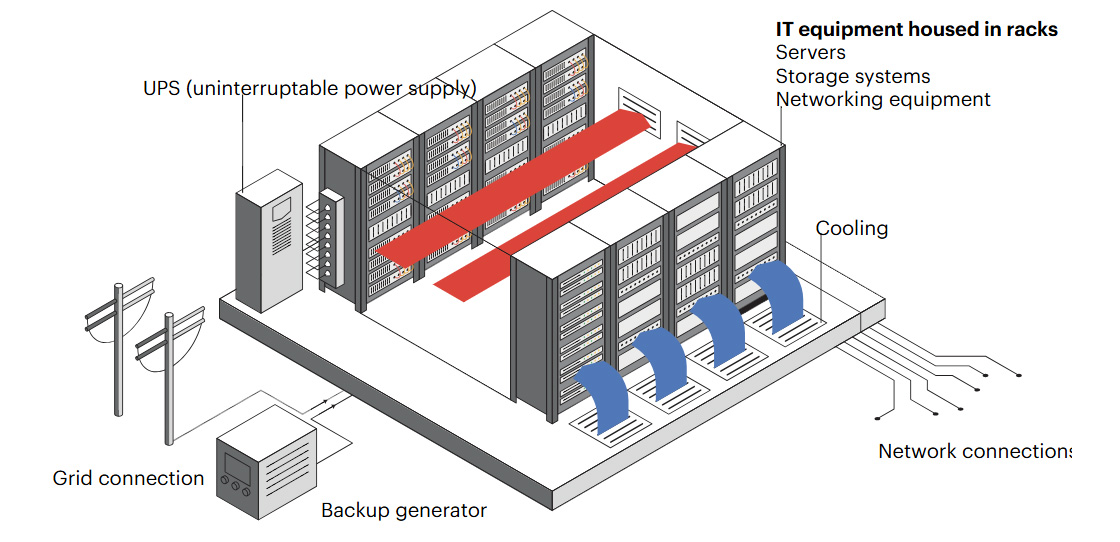
Data centers are not simply buildings filled with servers. They are energy-intensive industrial facilities that need a continuous and highly reliable supply of electricity.
And their electricity requirements are growing rapidly.
The International Energy Agency estimates that global data-center electricity consumption will more than double by 2030, reaching around 945 TWh per year in its base case. From 2024 to 2030, data-center electricity demand is projected to grow by around 15% annually — more than four times the growth rate of electricity consumption from other sectors.
The United States provides an even sharper illustration. According to the U.S. Department of Energy and Lawrence Berkeley National Laboratory, data centers consumed approximately 4.4% of total U.S. electricity in 2023. By 2028, that share could reach between 6.7% and 12%, depending on how quickly data-center demand develops.
These numbers are significant not simply because they are large. They are significant because this demand is arriving quickly and in concentrated locations. That creates a very different challenge for electricity systems.
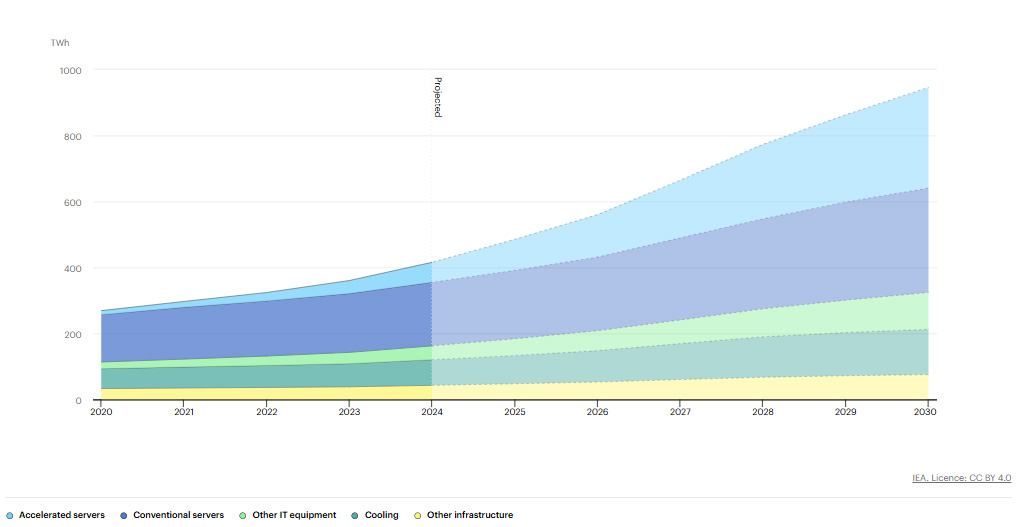
Last updated 10 Apr 2025 – IEA
The Problem Is Not Just Generating More Electricity
The obvious response to rising demand is simple:
Build more power
But electricity infrastructure does not work that simply. A data center needs more than electricity somewhere on the grid. It needs sufficient generation, transmission capacity, substations, grid connections and a reliable local network capable of delivering power when it is needed. This creates a distinction that is easy to miss:
Energy availability is not the same as power availability
A region may have abundant renewable resources, natural gas or other generation potential and still lack the transmission or grid infrastructure required to support a massive new data center.
The International Energy Agency expects the electricity supply associated with data-center demand to grow from around 460 TWh in 2024 to more than 1,000 TWh by 2030. It estimates that renewables will provide nearly half of the additional supply over the next five years, with natural gas and coal also contributing and nuclear becoming increasingly important toward the end of the decade and beyond.
- But generation takes time.
- Transmission takes time.
- Permitting takes time.
- Grid connections take time.
And that creates the central mismatch:
AI demand can emerge faster than the electricity infrastructure needed to serve it.
The Grid Is Becoming an AI Constraint
This mismatch is already appearing in electricity planning. In the United States, utilities and regulators are dealing with a wave of proposed data-center projects whose combined electricity requirements can be extraordinarily large.
Texas recently paused new data-center grid connections while regulators examined a surge of electricity requests exceeding 700 GW — more than ten times the estimated current electricity use of all U.S. data centers.
The problem is not that all of this demand will necessarily materialize. Some projects may never be built. Some may lack financing. Some may be speculative.
Reuters has described this phenomenon as “ghost demand”: electricity requests that appear in planning forecasts but may never become real consumption. Texas and other states are therefore trying to distinguish credible projects from speculative ones before committing scarce grid capacity and infrastructure investment.
This creates a difficult planning problem. If utilities overestimate AI demand, they could invest billions in infrastructure that is ultimately underused.
If they underestimate it, the opposite happens:
the grid becomes the bottleneck.
And that bottleneck can delay projects that already have capital, technology and customers waiting for them.
The Geography of AI Could Change
Power availability may also begin to influence where AI infrastructure is built.
Historically, data-center locations were strongly influenced by factors such as connectivity, land, taxes, latency, cooling conditions and proximity to customers.
Energy is becoming a more prominent factor in that equation. Consider Argentina’s Patagonia. Reuters recently reported growing interest from technology companies and investors in the region as a potential destination for large data centers. Patagonia offers a combination of relatively cool conditions, renewable energy potential, natural-gas resources and large areas of available land. Projects under consideration range from tens of megawatts to several gigawatts.
The significance is larger than Argentina itself. If electricity becomes a binding constraint in traditional technology hubs, locations with abundant and scalable energy resources become strategically more attractive. The result could be a subtle shift in the geography of AI:
The next AI hubs may increasingly emerge where power is available, not simply where technology companies already are.
In that world, energy infrastructure becomes a location advantage.
Power Density Is Becoming a Design Problem
There is another dimension to the challenge. It is not only the total amount of electricity that matters.
It is how much power is required in a specific location.
AI workloads can create very high power densities within data centers. That puts additional pressure on electrical equipment, cooling systems, substations and local distribution infrastructure.
The infrastructure surrounding the computing equipment therefore becomes increasingly important. Transformers, switchgear, cooling systems, power-management technologies and other electrical components are becoming critical parts of the data-center expansion.
Reuters has reported strong demand for companies involved in power and cooling infrastructure as the AI data-center build-out accelerates. This is an important shift in perspective. The AI boom is not creating demand only for more computing.
It is creating demand for everything required to deliver and sustain electricity at very high density.
The Race for Power Is Also a Race for Time
One of the least visible constraints may be time. A company can decide to deploy a new AI system relatively quickly. A data center can be designed and constructed on an aggressive schedule. But the electricity infrastructure supporting it may require a much longer development cycle.
A new transmission project can involve planning, regulatory review, permitting, procurement and construction. Generation projects face their own timelines. Grid upgrades may depend on investments that serve multiple users rather than a single data center.
This creates an uncomfortable asymmetry:
The technology industry is optimized for speed. The energy system is optimized for reliability, planning and physical durability.
AI companies want capacity now. Power systems have to be built for decades. The gap between those two timelines may become increasingly important.
Electricity Could Become a Strategic AI Resource
This is where the issue becomes more than an engineering problem. If reliable power becomes scarce in locations where AI demand is concentrated, access to electricity starts to acquire strategic value.
A company may have access to capital. It may have access to advanced AI hardware. It may have the expertise to build and operate a sophisticated data center. But if it cannot secure sufficient power, none of those advantages can be fully utilized. That changes the strategic equation.
The competition around AI could increasingly involve not only:
Who has the best technology? but also: Who can secure the physical resources required to operate it at scale?
This is already becoming relevant to national policy.
In South Korea, for example, the government is preparing for a substantial increase in electricity demand associated with semiconductor manufacturing and new AI data centers. Reuters reported on September 8 that officials estimate an additional requirement of 25–30 GW, roughly equivalent to the output of about 20 nuclear reactors, while the country considers its longer-term energy strategy.
The example illustrates the broader issue:
AI policy is increasingly becoming energy policy.
More Efficient AI Will Help — But It May Not Solve the Problem
There is an important counterargument. AI systems are becoming more efficient.
Software optimization can reduce the energy required for a given amount of computation. Hardware is becoming more efficient. Cooling technologies are improving. Data-center designs are becoming more sophisticated.
These improvements matter. The IEA notes that efficiency gains at the software, hardware and infrastructure levels can significantly reduce energy consumption per unit of compute.
But efficiency does not necessarily mean total electricity demand will fall. If the cost of running AI decreases while the number of AI applications increases dramatically, overall demand can still rise. This is the classic tension between efficiency and scale.
AI may become more energy-efficient per task while simultaneously becoming much more energy-intensive in aggregate. That is why the question is not simply:
How much energy does one AI task consume?
It is:
How much AI activity will the world ultimately run?
The Hidden Competition
The AI industry has spent years competing for chips, talent and capital. Now another competition is emerging beneath the surface:
the competition for reliable power.
And this competition may involve players that are not traditionally considered part of the technology industry.
- Utilities.
- Energy developers.
- Grid operators.
- Transmission companies.
- Nuclear and gas producers.
- Renewable-energy developers.
- Power-equipment manufacturers.
- Governments and regulators.
They are becoming part of the AI ecosystem because the ability to build AI at scale increasingly depends on the ability to power it. McKinsey estimates that global spending on data centers could approach $7 trillion by 2030, with the success of this build-out depending partly on the availability of energy resources.
The implication is important:
The AI economy is beginning to intersect directly with the physical economy of energy.
The Question Behind the Question
The conventional AI conversation asks whether technology can become more intelligent, more capable and more autonomous. But another question sits underneath it.
Can the physical world support the scale at which we want AI to operate?
That question leads somewhere different. It moves the conversation away from model performance and toward physical constraints. Away from algorithms and toward electricity. Away from what AI can do toward what the infrastructure supporting AI can sustain.
Because every AI system ultimately depends on something remarkably physical:
a reliable supply of energy.
And if demand grows faster than the grid can adapt, electricity may become the limiting factor long before technological ambition runs out.
The HENARCO View
The interesting issue is not that AI consumes a lot of electricity. That is already becoming widely understood. The deeper issue is that power is moving from being an assumed input of technology to becoming a strategic constraint on technology.
For organizations evaluating AI investments, this changes the questions they should be asking.
It is no longer enough to ask:
Which model should we use?
Or:
How much compute do we need?
The larger question may be:
What physical infrastructure will this AI strategy depend on — and can that infrastructure scale with us?
At the national and regional level, the question becomes even more consequential. Countries competing for AI investment may increasingly compete on their ability to provide:
- reliable electricity
- scalable generation
- transmission capacity
- grid connectivity
- predictable energy costs
- and sufficient infrastructure to support long-term demand
This could create a new form of competitive advantage. Not technological. Not purely financial. Physical. The strategic advantage may increasingly belong to those who can connect intelligence to the physical systems required to sustain it.
Compute determines what AI can process.
Power determines how much of it can actually run.
And that distinction may become one of the most important questions in the next phase of AI.
Better Questions
Instead of asking:
How fast is AI advancing?
Ask:
How fast can the physical infrastructure, supporting AI advance?
Instead of:
How much compute can we build?
Ask:
How much reliable power can we secure to operate it?
And perhaps more importantly:
- Where will the next AI infrastructure be built — and is power availability driving that decision?
- Which regions can actually provide reliable electricity at the scale AI requires?
- Who pays for the grid expansion required by AI?
- How should utilities plan for AI demand when many proposed projects may never materialize?
- Could access to electricity become a competitive advantage in AI comparable to access to compute?
- What happens when the speed of AI expansion exceeds the speed of energy infrastructure development?
- Which AI investments remain economically viable if power becomes the scarce resource?
The deeper question is perhaps this:
If intelligence is becoming increasingly abundant, will energy become the scarce resource that determines who can actually deploy it at scale?
